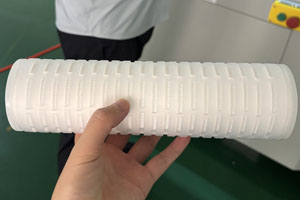
Common Problems in End Cap Welding and How to Solve Them
Views : 1766
Author : indrofiltermachine.com
Update time : 2026-07-06 12:47:43
Common Problems in End Cap Welding and How to Solve Them Introduction
End cap welding is one of the most critical manufacturing processes in the production of pleated filter cartridges. A properly welded end cap ensures that all liquid or gas passes through the filtration media, preventing bypass leakage and maintaining the cartridge's filtration efficiency. Poor welding quality, however, can lead to leaks, structural weakness, premature cartridge failure, and customer complaints. As filtration standards continue to become more demanding in industries such as water treatment, pharmaceuticals, food and beverage, electronics, and chemical processing, manufacturers must maintain consistent welding quality throughout production. Achieving reliable welds requires the right equipment, stable process parameters, suitable materials, and effective quality control.
This article discusses the most common problems encountered during end cap welding and provides practical solutions to improve product quality and production efficiency.
Why End Cap Welding Is Critical
The end caps connect the pleated filter element to the filter housing while sealing the filter media to prevent unfiltered fluid from bypassing the cartridge.
A high-quality welded joint must provide:
Complete leak-proof sealing
Strong mechanical bonding
Accurate dimensional alignment
Long-term durability
Resistance to pressure fluctuations
Consistent performance throughout the cartridge's service life
Even small welding defects can compromise the entire filtration system.
Problem 1: Weak Weld Strength Causes
Weak welds are among the most common manufacturing defects. They are often caused by:
Insufficient heating temperature
Inadequate heating time
Low welding pressure
Poor material compatibility
Contaminated welding surfaces
When the plastic does not reach its proper melting temperature, the molecular bond between the filter media and the end cap remains incomplete. Solutions
Manufacturers can improve weld strength by:
Optimizing heating temperature
Increasing heating time within recommended limits
Applying consistent welding pressure
Cleaning components before welding
Using compatible plastic materials
Regularly calibrating welding equipment
Proper parameter control greatly improves bonding quality.
Problem 2: Excessive Material Melting Causes
Applying excessive heat may cause plastic deformation, overflow, or distortion of the end cap.
Common reasons include:
Overheating
Long heating cycles
Excessive pressure
Poor temperature control
Over-melted plastic may block fluid flow or affect cartridge dimensions. Solutions
To prevent overheating:
Reduce heating time
Lower welding temperature
Monitor heating consistency
Use automatic temperature control systems
Verify process settings during production
Balanced heating produces strong welds without damaging components.
Problem 3: Fluid Bypass Leakage Causes
Leakage occurs when gaps remain between the filter media and the welded end cap.
Possible causes include:
Incomplete welding
Poor media positioning
Uneven pressure distribution
Misaligned components
Damaged end caps
Even microscopic leakage can significantly reduce filtration efficiency. Solutions
Leakage can be minimized by:
Improving fixture accuracy
Maintaining precise component alignment
Applying uniform welding pressure
Inspecting welding surfaces before assembly
Performing routine leak testing
Stable production processes help eliminate bypass defects.
Problem 4: End Cap Misalignment Causes
Incorrect positioning during welding may produce cartridges that cannot fit properly into filter housings.
Misalignment often results from:
Worn positioning fixtures
Operator errors
Poor automation accuracy
Inconsistent loading procedures
Solutions
Manufacturers should:
Use precision positioning fixtures
Replace worn locating components
Introduce automated loading systems
Verify alignment before each welding cycle
Accurate positioning improves both assembly quality and customer satisfaction.
Problem 5: Surface Burning or Discoloration Causes
Burn marks or discoloration usually indicate excessive localized heating.
Possible reasons include:
High heating temperatures
Uneven heat distribution
Dirty heating equipment
Prolonged heating cycles
Although appearance may be the first concern, overheating can also weaken the welded joint. Solutions
Prevent surface defects by:
Optimizing infrared or heating parameters
Keeping heating systems clean
Ensuring uniform temperature distribution
Monitoring heating cycles continuously
A stable thermal process produces cleaner welds and more attractive finished products.
Problem 6: Inconsistent Weld Quality Causes
Variation between production batches often results from inconsistent process control.
Contributing factors include:
Manual operation
Temperature fluctuations
Pressure variation
Equipment wear
Different operator techniques
Inconsistent welding increases rejection rates and reduces production efficiency. Solutions
Manufacturers can improve consistency through:
Automated welding equipment
Programmable welding parameters
Regular equipment maintenance
Standardized operating procedures
Operator training
Statistical process monitoring
Automation significantly reduces process variation.
Advantages of Non-Contact Infrared Welding
Many manufacturers have replaced traditional hot plate welding with non-contact infrared welding technology.
Unlike contact heating methods, infrared welding transfers thermal energy without touching the plastic components.
Its advantages include:
Uniform heat distribution
Cleaner welding surfaces
Reduced material sticking
Improved weld consistency
Lower maintenance requirements
Strong molecular bonding
Better cosmetic appearance
Advanced infrared heating systems equipped with water-cooling technology provide even greater process stability by maintaining consistent operating temperatures during continuous production. This helps prevent overheating, reduces thermal drift, and ensures reliable welding quality throughout long production runs.
Importance of Process Monitoring
Successful end cap welding depends on continuous process control.
Key production parameters include:
Heating temperature
Heating duration
Welding pressure
Cooling time
Component positioning
Cycle consistency
Modern welding machines equipped with programmable logic controllers (PLCs) and human-machine interfaces (HMIs) allow operators to monitor and adjust these parameters in real time.
Digital process monitoring also improves production traceability and simplifies troubleshooting.
Quality Control After Welding
Every finished filter cartridge should undergo comprehensive inspection before shipment.
Typical quality control procedures include: Visual Inspection
Operators examine:
Weld appearance
Surface finish
Alignment
Plastic deformation
Leak Testing
Leak testing verifies complete sealing between the end cap and filter media. Pressure Testing
Pressure tests confirm structural integrity under operating conditions. Pull Strength Testing
Mechanical testing evaluates the strength of the welded joint. Flow Performance Testing
Flow tests ensure the cartridge meets its required pressure drop and filtration performance.
Comprehensive quality control reduces field failures and enhances customer confidence.
Conclusion
End cap welding is one of the most important manufacturing processes in producing high-performance pleated filter cartridges. Problems such as weak welds, excessive melting, leakage, misalignment, discoloration, and inconsistent quality can all affect filtration efficiency and product reliability if left unaddressed.
By optimizing welding parameters, maintaining precise component alignment, implementing automated production systems, and adopting advanced non-contact infrared welding technology, manufacturers can significantly improve weld quality and production consistency. Combined with rigorous inspection and testing procedures, these improvements help produce leak-proof filter cartridges that meet the demanding requirements of water treatment, pharmaceutical, food and beverage, electronics, and industrial filtration applications.
Investing in advanced welding equipment and standardized manufacturing practices not only reduces production defects and operating costs but also strengthens customer confidence by delivering filter cartridges with exceptional performance, durability, and long-term reliability.