Multi-Layer Media Pleating: How to Handle Graded Density Layers
Views : 1424
Author : indrofiltermachine.com
Update time : 2026-07-06 12:32:12
Multi-Layer Media Pleating: How to Handle Graded Density Layers Introduction
As filtration technology advances, industrial filter cartridges are expected to deliver higher filtration efficiency, greater dirt-holding capacity, lower pressure drop, and longer service life. To meet these demanding requirements, manufacturers increasingly use multi-layer filtration media with graded density structures instead of traditional single-layer materials.
Graded density media consist of multiple filtration layers with progressively finer pore structures. The outer layers capture larger particles, while the inner layers remove progressively smaller contaminants. This staged filtration mechanism maximizes contaminant retention, reduces pressure loss, and significantly extends the operational life of the filter cartridge.
However, manufacturing filter cartridges with multi-layer media presents unique challenges. Different materials often have varying thicknesses, stiffness, elasticity, and thermal properties. Without proper pleating technology and process control, manufacturers may encounter pleat distortion, media separation, inconsistent pleat spacing, or reduced filtration performance.
This article explores the challenges of pleating graded density filter media and explains how modern pleating equipment and production techniques ensure consistent, high-quality filter cartridge manufacturing.
Understanding Graded Density Filter Media
Unlike conventional single-layer filter media, graded density media combine two or more filtration layers into one composite structure. A typical construction includes:
Outer coarse layer for capturing large particles
Intermediate transition layer for distributing particle loading
Inner fine filtration layer for removing microscopic contaminants
Support layer for maintaining structural stability
As fluid flows through the media, contaminants are captured progressively rather than accumulating only on the surface. This depth filtration mechanism increases dirt-holding capacity and extends filter service life.
Graded density media are widely used in:
Water treatment
Reverse osmosis pre-filtration
Food and beverage processing
Pharmaceutical filtration
Electronics manufacturing
Chemical processing
Industrial process filtration
Challenges of Pleating Multi-Layer Media
Although graded density media provide superior filtration performance, they are more difficult to process than single-layer materials.
Common manufacturing challenges include:
Uneven pleat formation
Layer shifting during pleating
Delamination between layers
Excessive material stress
Wrinkles or buckling
Variable pleat height
Reduced structural stability
Each layer may respond differently to bending forces, making accurate pleat formation more complex.
Maintaining Layer Alignment
One of the most important requirements in multi-layer pleating is maintaining perfect alignment between all filtration layers.
If layers shift during production, problems may include:
Reduced filtration efficiency
Inconsistent flow distribution
Poor sealing during end cap welding
Increased bypass risk
Lower mechanical strength
Modern pleating machines use precision guiding systems to keep every layer synchronized throughout the pleating process.
Automatic tension control ensures that all materials move together at identical speeds without stretching or slipping.
Controlling Material Tension
Different filtration materials exhibit different mechanical properties.
For example:
Polypropylene (PP) may be relatively flexible.
Polyester support layers are generally stronger.
Glass fiber media are more brittle.
Membrane materials require gentle handling.
Applying excessive tension can damage delicate filtration layers, while insufficient tension may result in unstable pleat formation.
Advanced pleating equipment incorporates programmable tension control systems that continuously adjust material feeding according to the characteristics of each media layer.
This allows manufacturers to process complex composite media with excellent consistency.
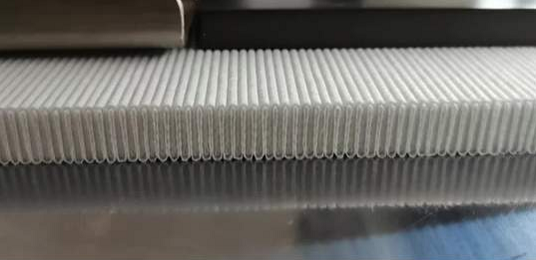
For graded density media, maintaining uniform pleat spacing becomes even more important because inconsistent pleats can cause localized flow restriction and uneven contaminant loading.
Servo-driven pleating systems provide accurate control over:
Pleat height
Pleat pitch
Pleat spacing
Pleat angle
Folding consistency
These parameters help maximize both filtration efficiency and cartridge durability.
Selecting the Right Pleating Equipment
Not all pleating machines are suitable for processing multi-layer filtration media.
Modern automatic pleating machines designed for composite materials typically feature:
Servo-controlled feeding systems
Independent tension adjustment
Precision pleating rollers
Automatic media alignment
Programmable production recipes
Real-time process monitoring
These features enable manufacturers to quickly switch between different media constructions while maintaining consistent product quality.
Integrating Pleating with Downstream Processes
Pleating is only the first stage of filter cartridge production.
After pleating, the media typically passes through several additional manufacturing steps, including:
Precision cutting
Center seam welding
Inner core installation
Outer cage assembly
End cap welding
Adapter welding
Quality inspection
Packaging
Proper pleat formation simplifies these downstream operations by ensuring consistent cartridge dimensions and accurate component alignment.
Well-formed pleats also improve end cap welding by creating uniform contact surfaces between the media and plastic components.
Advanced Infrared End Cap Welding
After pleating and assembly, the filter element is permanently sealed with plastic end caps.
Modern manufacturers increasingly use non-contact infrared welding technology because it offers several advantages over traditional hot plate welding.
Benefits include:
Uniform heating
Strong molecular bonding
Reduced material deformation
Cleaner weld surfaces
Improved dimensional accuracy
Consistent leak-proof sealing
Advanced infrared heating systems equipped with water-cooling technology provide even greater temperature stability during continuous production. By preventing overheating and maintaining precise heating conditions, these systems produce reliable welds while protecting delicate graded density media from thermal damage.
This combination of precision pleating and advanced welding technology ensures that the finished cartridge maintains both structural integrity and filtration performance.
Quality Control for Multi-Layer Filter Cartridges
Comprehensive quality control is essential when manufacturing cartridges with graded density media.
Typical inspection procedures include: Visual Inspection
Operators verify:
Uniform pleat spacing
Layer alignment
Surface cleanliness
Weld quality
Dimensional Inspection
Measurements confirm:
Cartridge length
Diameter
Pleat height
Pleat consistency
Pressure Drop Testing
Flow testing evaluates pressure loss across the cartridge to ensure efficient fluid movement. Filtration Efficiency Testing
Particle retention tests verify that the graded density media achieve the required filtration performance. Integrity Testing
Pressure and leak tests confirm that the completed cartridge is fully sealed and free from bypass leakage.
Applications of Graded Density Pleated Filter Cartridges
Multi-layer pleated cartridges are used in numerous demanding filtration applications, including:
Reverse osmosis pre-filtration
Desalination plants
Food and beverage production
Pharmaceutical manufacturing
Semiconductor ultrapure water systems
Chemical processing
Biotechnology
Industrial process water treatment
Fine chemical filtration
High-purity liquid filtration
These industries rely on graded density media to maximize contaminant removal while maintaining long service life and stable flow performance.
Conclusion
Multi-layer graded density filtration media have significantly improved the performance of modern pleated filter cartridges by combining high filtration efficiency with increased dirt-holding capacity and lower pressure drop. However, manufacturing these advanced cartridges requires precise control throughout the pleating process.
Maintaining layer alignment, controlling material tension, optimizing pleat geometry, and integrating automated production equipment are all essential for producing consistent, high-quality filter cartridges. When combined with precision cutting, reliable seam welding, advanced non-contact infrared end cap welding, and comprehensive quality testing, manufacturers can produce durable, leak-proof cartridges that meet the demanding requirements of today's filtration industry.
As filtration technologies continue to evolve, manufacturers equipped with advanced multi-layer pleating systems and intelligent production lines will be well positioned to deliver innovative filtration solutions for water treatment, pharmaceuticals, food and beverage processing, electronics, and many other industrial applications worldwide.